































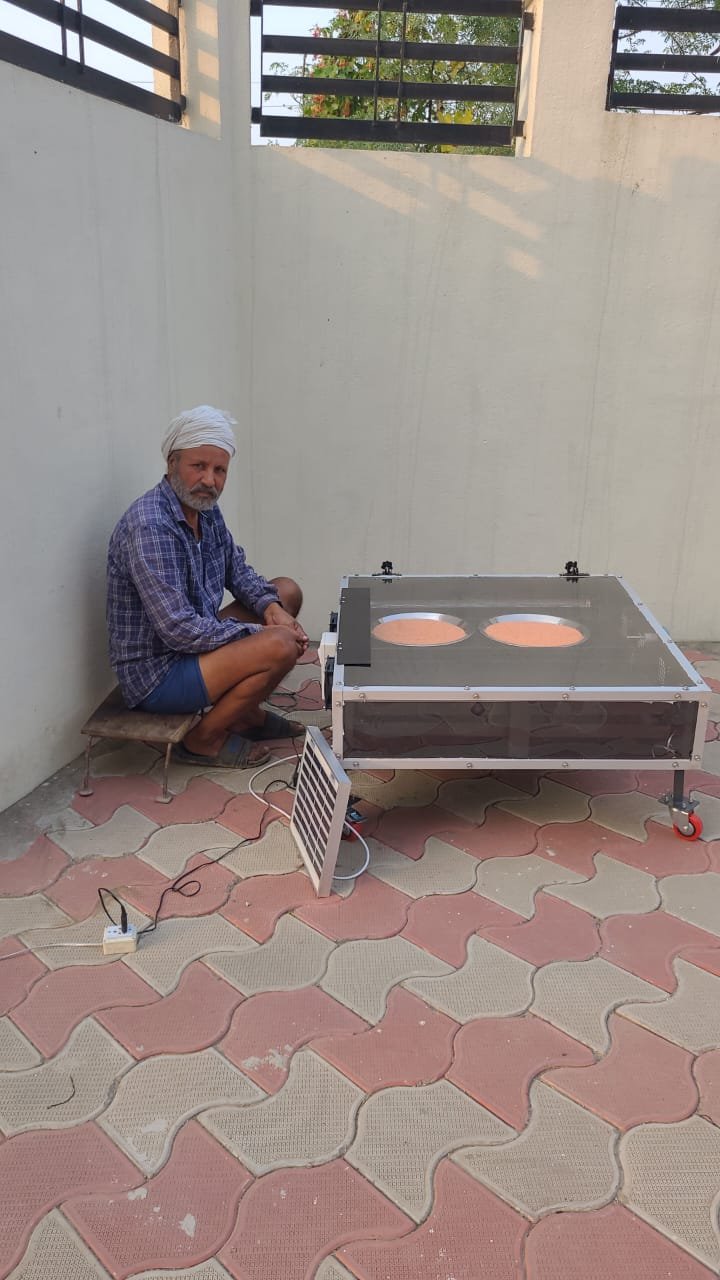
We dry turmeric and chilli for 400 member farmers now without ever watching the sky. The tunnel dryer paid for itself in one season, and the colour we retain has lifted our market price.
Southern India · Service area
Solar dryers, cookers & ovens in Puducherry
Solar drying solutions for Puducherry’s coconut, fruits, vegetables, fish and value-added food processing
Trusted by organisations across India
Quick answer
Rudra Solar Energy provides application-based solar drying solutions across Puducherry for suitable coconut products, banana, fruits, vegetables, spices, fish, seafood and value-added food-processing applications, with enclosed drying, managed airflow and multiple capacity options.
Puducherry is a geographically distinctive Union Territory comprising Puducherry, Karaikal, Mahe and Yanam. Its horticulture programmes support vegetables, fruits, banana and coconut, while the UT also has an established marine and inland fisheries economy.
This combination creates solar drying opportunities across suitable fruits, vegetables, coconut products, spices, seeds, fish and seafood. Enclosed solar drying with managed airflow can support protected moisture reduction for processors developing dried ingredients and other value-added food products.
Rudra Solar Energy provides multiple solar dryer capacities and application-specific configurations for farmers, SHGs, women entrepreneurs, fisheries groups, MSMEs and food-processing businesses in Puducherry. System selection should begin with the commodity, fresh batch quantity, initial and target moisture, tray-loading requirement, available installation area and intended final product.
Solar Drying for Coconut, Fruits, Vegetables and Horticultural Produce
Puducherry supports a diversified horticulture and food-processing environment across its Puducherry, Karaikal, Mahe and Yanam regions. Current government horticulture programmes promote vegetable and fruit cultivation, tissue-culture banana, coconut seedlings and home or backyard nutritional gardens. These product groups create opportunities for enclosed solar drying where controlled moisture reduction is required for fruits, vegetables, coconut products, spices, seeds and other suitable agricultural materials. A Rudra Solar Dryer can support protected tray-based processing with managed airflow, while drying conditions should be selected according to the commodity, initial moisture, target moisture, product preparation, loading depth and intended final use.
Solar Drying for Fish, Seafood and Micro Food Enterprises
Puducherry also has a strong coastal fisheries context, with marine and inland fishing communities spread across its four regions. The Union Territory has approximately 45 km of coastline, along with inland and brackish-water resources supporting fisheries-related livelihoods. For suitable fish and seafood products where drying forms part of the processing method, an enclosed solar dryer can support organized tray loading and reduced direct exposure to dust, insects and uncontrolled outdoor contact. Puducherry also has an active micro food-processing ecosystem under PMFME, creating relevance for SHGs, women entrepreneurs, MSMEs and small processors developing value-added food products.
Looking for the right system for Puducherry?
Browse our solar dryers, cookers, ovens and desalination units — or tell us your crop and we’ll size it for you.
Common questions about solar systems in Puducherry
Does Rudra Solar Energy supply and install in Puducherry?
Yes — we supply, install and support solar systems in Puducherry from our Gujarat base, including remote and off-grid sites. request a quote with your location and requirement.
Which solar systems work best in Puducherry?
All four families suit Puducherry: solar dryers, solar cookers, solar ovens and solar desalination systems. Tell us your crop or application and we will recommend the right model.
How do I get a quote for a project in Puducherry?
Share your application, target capacity and site details and our engineers respond within one working day — request a quote. You can also explore other regions in the locations we serve.
Can solar drying and cooking handle the climate in Puducherry?
Yes — India's solar resource supports year-round use, and hybrid backup covers monsoon or cloudy spells. See field results in our success stories.
What is the price of a solar dryer in Puducherry?
Solar dryer price depends on the commodity, fresh batch quantity, tray area, airflow requirement, construction, capacity and any application-specific customization. A banana processor, coconut enterprise, vegetable-processing unit and fish processor may require different system configurations even at a similar fresh batch weight. For an appropriate recommendation, share: Product to be dried Fresh batch quantity Installation region Available area Intended final product
Can coconut be dried using a Rudra Solar Dryer in Puducherry?
Yes, for suitable coconut-processing applications where controlled moisture reduction is required. Coconut cultivation is supported under Puducherry’s horticulture development programmes, including distribution of coconut seedlings. The correct drying process depends on: Coconut product or form Initial moisture Required final moisture Loading depth Airflow Intended processing or storage use A single fixed drying schedule should not be applied to every coconut product.
Can banana and other fruits be processed using solar drying in Puducherry?
Yes. Puducherry’s horticulture programme specifically supports tissue-culture banana seedlings as well as fruit cultivation. Suitable fruits may be processed into: Dried slices Dried pieces Powder ingredients after appropriate drying Other value-added products Fruit maturity, slice thickness, initial moisture, pre-treatment where applicable and tray loading should be considered before defining the process.
Can vegetables be converted into value-added products using a solar dryer?
Yes. Vegetable cultivation is actively supported through Puducherry’s horticulture programmes for both agricultural and nutritional-garden applications. Depending on the commodity, suitable vegetables can be processed into: Dried slices Flakes Powders Food ingredients Other value-added forms Uniform cutting and tray loading are particularly important because product thickness influences moisture-removal uniformity.
Is solar drying suitable for chilli, turmeric and other spices in Puducherry?
Yes, where deliberate moisture reduction is part of the processing requirement. Official Puducherry agricultural statistics have documented chilli and turmeric cultivation among spice crops. For spices, the process should consider: Harvested form Initial moisture Required final moisture Layer depth Airflow Temperature sensitivity Intended final use Different spices should not automatically be processed using the same settings.
Can fish and seafood be dried using a solar dryer in Puducherry?
Yes, for suitable fish and seafood products where drying is part of the intended processing method. Puducherry has a significant marine fisheries sector across its coastal regions, along with inland and brackish-water resources. For fish applications, important considerations include: Fish species Whole or cut form Product thickness Pre-treatment Food hygiene Initial moisture Target moisture Airflow Coastal humidity Appropriate seafood handling and food-safety practices remain essential throughout processing.
What solar dryer capacity is suitable for a small food business in Puducherry?
Capacity should be selected according to the fresh material loaded per batch, not only the expected dried-product weight. Important inputs include: Commodity Fresh batch quantity Initial and target moisture Product size or slice thickness Tray-loading depth Number of batches per day Available installation area Different products can require very different tray areas even when their fresh batch weights are identical.
Can women entrepreneurs and SHGs start value-added food businesses using solar drying?
Yes. An appropriately sized solar dryer can be relevant for women entrepreneurs, SHGs and micro food-processing enterprises working with suitable fruits, vegetables, coconut products, herbs, spices or other food materials. Puducherry has supported SHG members and micro enterprises through the PMFME food-processing framework, including seed capital, equipment support and training. The business model should first define the commodity, expected batch quantity, final product and target customer.
How is enclosed solar drying different from direct open sun drying in Puducherry?
Open sun drying leaves the product directly exposed to its surrounding environment. An enclosed solar dryer can help reduce direct exposure to: Dust Insects Birds Uncontrolled outdoor contact Managed airflow also helps carry moisture-laden air away from the material and supports more organized tray-based processing. This can be particularly relevant in coastal environments, but actual drying performance still depends on humidity, solar radiation, commodity and loading.
How long does solar drying take in Puducherry?
There is no universal drying time. Drying duration can change according to: Commodity Initial moisture Required final moisture Product thickness Tray loading Airflow Ambient humidity Solar radiation Weather Dryer configuration Puducherry’s coastal conditions can influence moisture removal, so the correct drying endpoint should be based on the actual product requirement rather than a fixed number of hours.
Explore other states we serve
All locations
Gujarat
Maharashtra
Rajasthan
Madhya Pradesh
Karnataka
Telangana
Andhra Pradesh
Tamil Nadu
Himachal Pradesh
Uttarakhand
Ladakh
Punjab
Bihar
Odisha
Meghalaya
Arunachal Pradesh
Nagaland
Assam
Chhattisgarh
Goa
Haryana
Jharkhand
Kerala
Manipur
Mizoram
Sikkim
Tripura
Uttar Pradesh
West Bengal
Andaman and Nicobar Islands
Chandigarh
Dadra and Nagar Haveli and Daman and Diu
Delhi (NCT of Delhi)
Jammu and Kashmir
Lakshadweep