





















Company News
Overall Impact Till Date: 20+ Years of Solar Innovation, Sustainable Processing and Livelihood Impact
Trusted by organisations across India
August 22, 2026 · By Rudra Administrator · 8 min read
Key takeaway
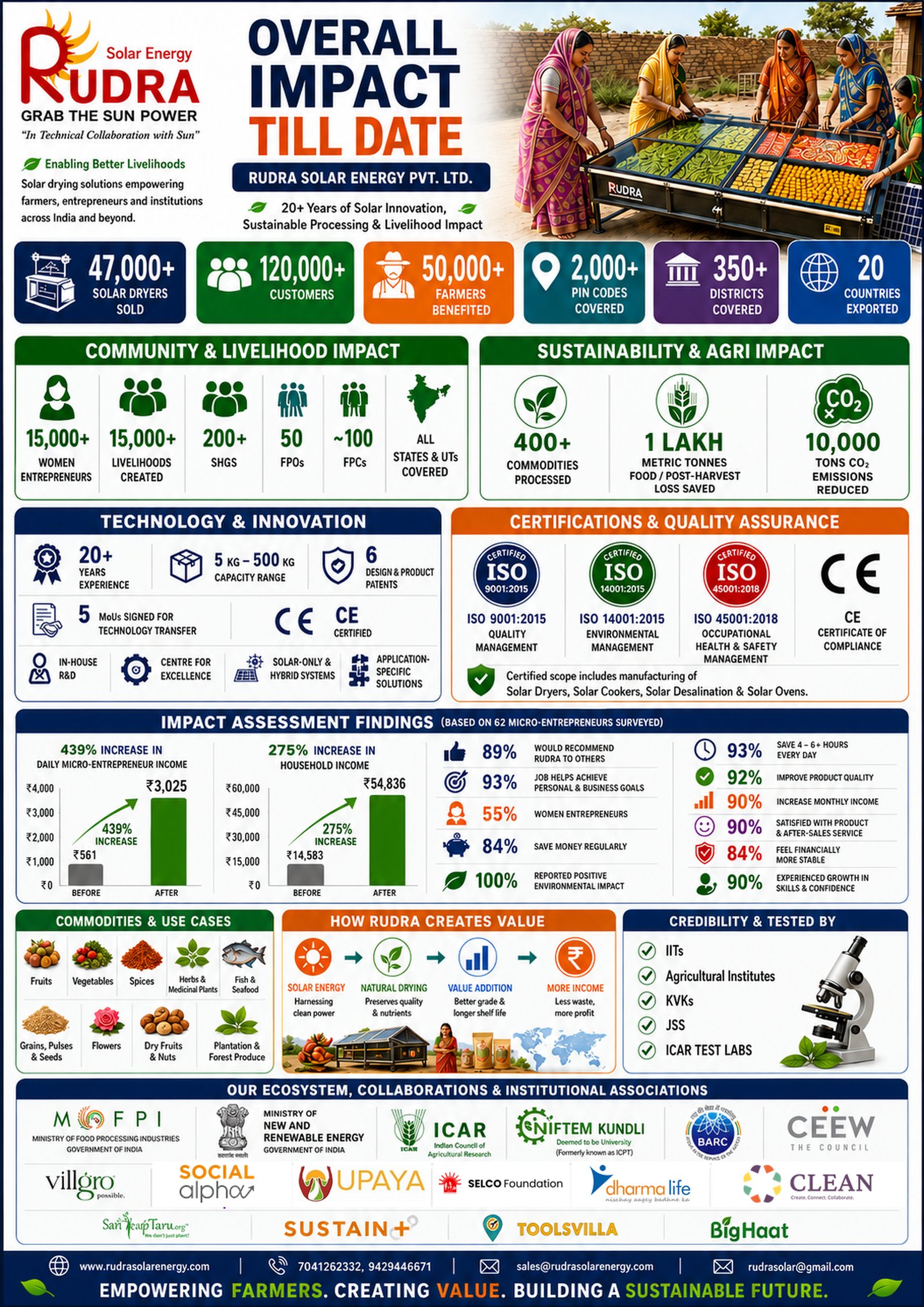
Rudra Solar Energy Pvt. Ltd.’s Overall Impact Till Date report covers more than 20 years of solar innovation and livelihood-focused agricultural processing. The company reports 47,000+ solar dryers sold, 120,000+ customers, 50,000+ farmers benefited, coverage across 2,000+ PIN codes and 350+ districts, and exports to 20 countries. Reported community impact includes 15,000+ women entrepreneurs, 15,000+ livelihoods, 200+ SHGs, 50 FPOs and approximately 100 FPCs. Sustainability figures include 400+ commodities processed, 1 lakh metric tonnes of food and post-harvest loss saved and 10,000 tonnes of CO₂ emissions reduced. These are company-reported cumulative figures.
20+ Years of Solar Innovation and Livelihood Impact
Rudra Solar Energy Pvt. Ltd. has completed more than 20 years of work in solar innovation, sustainable agricultural processing and livelihood-focused technology.
The Overall Impact Till Date report brings together the company’s cumulative reach, community outcomes, sustainability contribution, technological capabilities, quality systems and findings from an impact assessment involving micro-entrepreneurs.
From small rural enterprises to institutional and commercial applications, Rudra Solar Energy has worked to make protected solar drying accessible to farmers, women entrepreneurs, Self-Help Groups, Farmer Producer Organisations, food processors and development programmes across India and beyond.
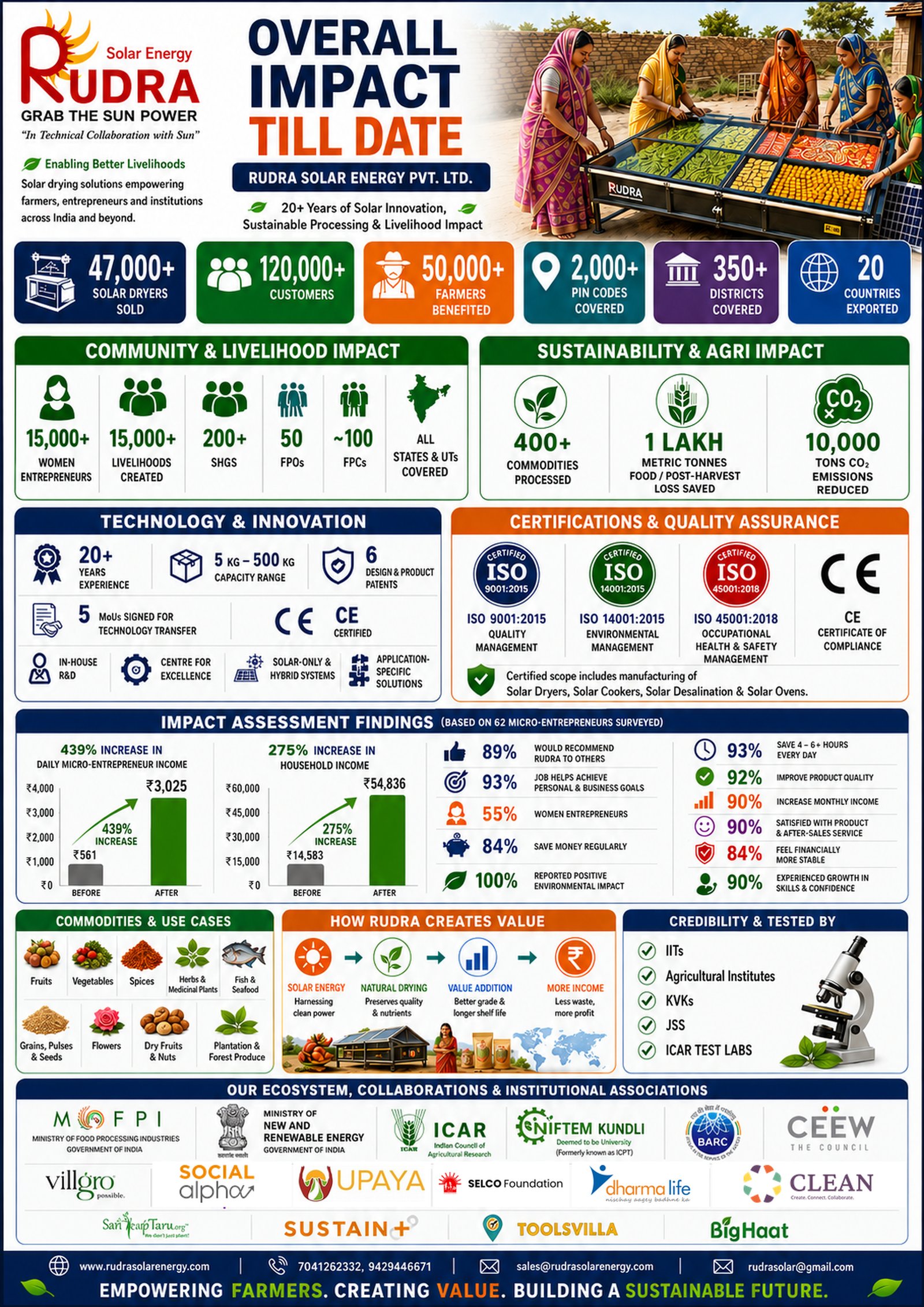
Rudra Solar Energy’s Overall Reach Till Date
The following company-reported cumulative figures represent Rudra Solar Energy’s reach across products, customers, farmers and geographic markets:
- 47,000+ solar dryers sold
- 120,000+ customers
- 50,000+ farmers benefited
- 2,000+ PIN codes covered
- 350+ districts covered
- 20 countries exported to
This reach includes different user groups, dryer capacities, commodities and operating environments.
Dryer selection and performance depend on the application, processing volume, commodity characteristics, initial and target moisture levels, preparation method, tray loading, airflow, local weather and operating practices.
Community and Livelihood Impact
Solar drying can support local value addition by enabling suitable agricultural and food products to be processed closer to the place of production.
Rudra Solar Energy reports the following cumulative community and livelihood reach:
- 15,000+ women entrepreneurs supported
- 15,000+ livelihoods created
- 200+ Self-Help Groups reached
- 50 Farmer Producer Organisations reached
- Approximately 100 Farmer Producer Companies reached
- All Indian States and Union Territories covered
Women entrepreneurs, SHGs, FPOs and FPCs can use solar drying for suitable livelihood and food-processing activities.
Successful enterprise development also requires access to appropriate raw materials, correct processing practices, hygiene, packaging, pricing, quality management and suitable markets. Access to a solar dryer creates a processing opportunity, but it does not independently guarantee commercial success.
Sustainability and Agricultural Impact
Rudra Solar Energy’s reported cumulative sustainability and agricultural impact includes:
- 400+ commodities processed
- 1 lakh metric tonnes of food and post-harvest loss saved
- 10,000 tonnes of CO₂ emissions reduced
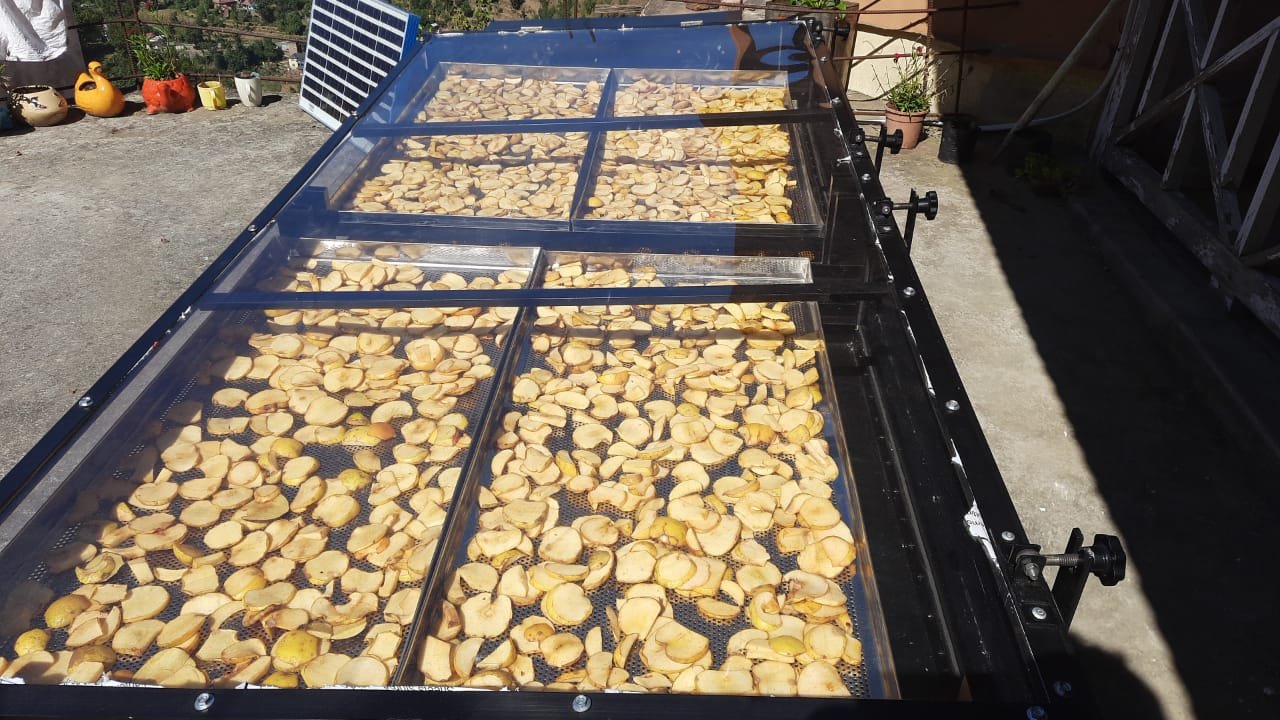
Solar drying uses available solar energy to remove moisture from suitable agricultural and food products. Depending on the system and application, it can reduce direct exposure to open-air dust, insects and other environmental contaminants.
Solar-only systems can also reduce dependence on conventional fuel or electricity for suitable drying applications.
Environmental and loss-reduction outcomes vary according to dryer utilisation, commodity, batch size, solar radiation, weather conditions, conventional process replaced and the methodology used to calculate cumulative impact.
Technology and Innovation Capabilities
Rudra Solar Energy combines product development, application engineering, manufacturing and field experience to address different solar drying requirements.
The company reports:
- 20+ years of experience
- 5 kg to 500 kg capacity range
- 6 design and product patents
- 5 MoUs signed for technology transfer
- In-house research and development
- Centre for Excellence
- Solar-only and hybrid systems
- Application-specific solutions
- CE-certified solutions within the applicable scope
Different commodities cannot be dried using one universal time or temperature.
Drying performance is influenced by the commodity’s initial moisture, desired final moisture, preparation, thickness, tray loading, airflow, temperature, humidity, solar radiation, dryer design and local weather.
For this reason, the commodity, daily processing requirement and intended final product should be evaluated before selecting a solar dryer.
Certifications and Quality Assurance
Rudra Solar Energy reports the following management-system certifications and compliance coverage:
- ISO 9001:2015 — Quality Management
- ISO 14001:2015 — Environmental Management
- ISO 45001:2018 — Occupational Health and Safety Management
- CE Certificate of Compliance
The stated certified manufacturing scope includes:
- Solar Dryers
- Solar Cookers
- Solar Desalination Systems
- Solar Ovens
Certification and compliance claims should be interpreted according to the relevant certificate, product category, model and applicable validity period.
A general certification statement should not be treated as confirmation that every individual product model has undergone the same product-specific testing or certification process.
Independent Evidence Behind the Survey Findings
The micro-entrepreneur outcomes included in this Overall Impact summary are drawn from an external third-party impact assessment carried out by Social Lens in collaboration with Upaya Social Ventures. The assessment covered 62 micro-entrepreneurs and examined reported changes in income, time savings, product quality, financial stability, women’s participation, satisfaction, skills and environmental impact.
These third-party survey findings are separate from Rudra Solar Energy’s cumulative company-reported figures, including solar dryers sold, customer reach, geographic coverage, livelihood reach and sustainability estimates. This distinction is maintained to ensure transparent and responsible impact communication.
Impact Assessment Findings from 62 Micro-Entrepreneurs
In addition to cumulative company-level impact figures, Rudra Solar Energy’s impact assessment examined the experiences reported by 62 micro-entrepreneurs across India.
The assessment focused on income, time savings, women’s participation, product quality, financial resilience, enterprise satisfaction, skills and environmental outcomes.
Reported Increase in Daily Micro-Entrepreneur Income
The assessment reports a 439% increase in average daily micro-entrepreneur income.
- Before using the solar dryer: ₹561 per day
- After using the solar dryer: ₹3,025 per day
- Reported increase: 439%
These figures represent the average income change reported for the entrepreneurs included in the assessment.
Actual income can vary according to the commodity processed, processing scale, dryer utilisation, season, selling price, product quality, packaging, local demand and market access.
The reported figures should not be interpreted as a guaranteed income outcome for every Rudra Solar Dryer user.
Reported Increase in Average Household Income
The assessment reports a 275% increase in average monthly household income.
- Before: ₹14,583 per month
- After: ₹54,836 per month
- Reported increase: 275%
The reported change indicates that a regularly operated solar drying enterprise may contribute to wider household financial capacity when supported by consistent production and market access.
These figures are findings from the assessed group and should not be treated as universal income projections.
Additional Participant-Reported Findings
The impact assessment reported the following outcomes:
- 89% would recommend Rudra to others
- 93% reported that their work helps them achieve personal and business goals
- 55% of surveyed participants were women entrepreneurs
- 84% reported saving money regularly
- 100% reported a positive environmental impact
- 93% reported saving four to six or more hours every day
- 92% reported improved product quality
- 90% reported increased monthly income
- 90% were satisfied with the product and after-sales service
- 84% felt financially more stable
- 90% experienced growth in skills and confidence
These findings reflect the experiences reported by the surveyed participants. They should not be interpreted as guaranteed outcomes or as proof that every reported change was caused exclusively by the solar dryer.
Women’s Participation in Solar Drying Enterprises
Women represented 55% of the micro-entrepreneurs included in the impact assessment.
Solar drying can support women-led processing activities by enabling suitable agricultural produce to be converted into dried and potentially higher-value products within a local enterprise setting.
Depending on the project, this can support women entrepreneurs involved in Self-Help Groups, household enterprises, community food-processing activities and rural livelihood programmes.
Training, appropriate capacity selection, access to raw materials, product preparation, quality control, packaging and market linkages remain important for long-term enterprise development.
Time Savings and Product-Quality Outcomes
A total of 93% of surveyed participants reported saving four to six or more hours every day.
An enclosed solar drying system can reduce the repeated handling and monitoring often associated with traditional open sun drying. The time saved may be used for preparation, packaging, sales, household responsibilities or other enterprise activities.
The assessment also found that 92% of participants reported improvement in product quality.
Rudra Solar Dryers create a protected hot-air drying environment designed to reduce direct exposure to dust, insects and other outdoor contaminants. Managed airflow and appropriate tray loading can support more consistent drying when the system is operated correctly.
Final product quality still depends on:
- Raw-material quality
- Commodity preparation
- Slice size or material thickness
- Initial and target moisture levels
- Tray loading
- Drying temperature and airflow
- Solar radiation and local weather
- Hygiene during handling
- Packaging and storage after drying
The 92% figure represents participant-reported quality improvement. It should not be interpreted as a laboratory certification for every product processed.
Financial Stability, Skills and Confidence
A total of 84% of surveyed participants reported feeling financially more stable, while 90% reported growth in skills and confidence.
Reported areas of skill development included:
- Business management
- Financial management
- Marketing and sales
- Product-quality management
- Digital and technology usage
Solar drying creates an opportunity for value-added processing, but enterprise growth also depends on production planning, hygiene, packaging, pricing, customer development and access to markets.
Environmental Impact Reported by Participants
All surveyed participants reported a positive environmental impact.
Solar-only drying systems primarily use available solar energy for the drying process. Depending on the application, this may reduce the use of conventional fuel or electricity.
However, the 100% figure represents participant perception reported through the survey. It is not presented as a product-level life-cycle assessment or as a quantified carbon-saving claim for every individual dryer.
The scale of environmental benefit varies according to the dryer model, operating conditions, usage frequency and the conventional drying method being replaced.
Commodities and Solar Drying Use Cases
Rudra Solar Dryers have been used across more than 400 commodities.
Major application categories include:
- Fruits
- Vegetables
- Spices
- Herbs and medicinal plants
- Fish and seafood
- Grains, pulses and seeds
- Flowers
- Dry fruits and nuts
- Plantation and forest produce
Every commodity requires an appropriate preparation method, drying environment and target moisture level.
Pre-processing, post-drying conditioning, moisture testing, packaging and storage are separate stages and should be planned according to the commodity and its intended market.
How Rudra Solar Energy Creates Value
The value-creation process connects solar energy, protected drying, value addition and market opportunity.
Solar Energy
The system harnesses available solar energy to generate heat for drying.
Drying conditions and output depend on solar radiation, weather and system configuration.
Protected Hot-Air Drying
A protected drying chamber with managed airflow can support cleaner handling and more consistent drying than direct exposure to open surroundings when the dryer is operated correctly.
Value Addition
Appropriate drying may support better utilisation of seasonal or perishable produce and create opportunities for graded, packaged and market-ready products.
Income Opportunity
Reduced losses and the sale of processed products may create additional income opportunities.
Actual profitability depends on raw-material cost, production volume, output quality, packaging, pricing and market demand.
Testing, Validation and Technical Credibility
Rudra Solar Energy reports testing and validation engagement through:
- IITs
- Agricultural institutes
- Krishi Vigyan Kendras
- JSS
- ICAR test laboratories
The type and scope of testing may differ by product, model, project and institution.
References to institutional testing should not be interpreted as a universal endorsement or identical certification of every Rudra Solar Energy product.
Ecosystem, Collaborations and Institutional Associations
Rudra Solar Energy’s reported ecosystem, collaborations and institutional associations include organisations working across food processing, renewable energy, agricultural research, innovation, social impact, rural livelihoods and market access.
The organisations presented in the Overall Impact Till Date report include:
- Ministry of Food Processing Industries
- Ministry of New and Renewable Energy
- Indian Council of Agricultural Research
- NIFTEM Kundli
- Bhabha Atomic Research Centre
- Council on Energy, Environment and Water
- Villgro
- Social Alpha
- Upaya Social Ventures
- SELCO Foundation
- Dharma Life
- CLEAN — Create. Connect. Collaborate.
- SankalpTaru.org
- SUSTAIN+
- TOOLSVILLA
- BigHaat
The nature, duration and scope of engagement may vary between institutions, projects and programmes.
Inclusion in this ecosystem section does not imply that every listed organisation has the same type of formal partnership, product approval or certification relationship with Rudra Solar Energy.
Responsible Interpretation of the Impact Figures
The figures on this page include cumulative company-reported impact numbers and responses collected through the micro-entrepreneur impact assessment.
The information should be interpreted with the following considerations:
- Survey findings are based on participant responses
- Income and livelihood outcomes can differ between users
- Percentages may be rounded
- Environmental outcomes depend on system usage and the process replaced
- Product-quality results do not replace commodity-specific laboratory testing
- Certification and testing scope can vary by model and product
- Enterprise success depends on utilisation, processing practices and market access
This transparent interpretation helps customers, institutions and development organisations understand both the relevance and limitations of the reported findings.
Empowering Farmers, Creating Value and Building a Sustainable Future
Rudra Solar Energy’s overall impact reflects the connection between practical solar innovation, agricultural value addition and livelihood development.
The company continues to work with farmers, entrepreneurs, SHGs, FPOs, food processors, institutions and development organisations seeking application-specific solar drying solutions.
For solar dryer selection, institutional projects or livelihood-programme enquiries, contact Rudra Solar Energy Pvt. Ltd.
Website: www.rudrasolarenergy.com
Phone: 7041262332, 9429446671
Email: sales@rudrasolarenergy.com
Alternative Email: rudrasolar@gmail.com
Related reading
Keep exploring
Solar systems & more from Rudra Solar
Solar systems in this guide